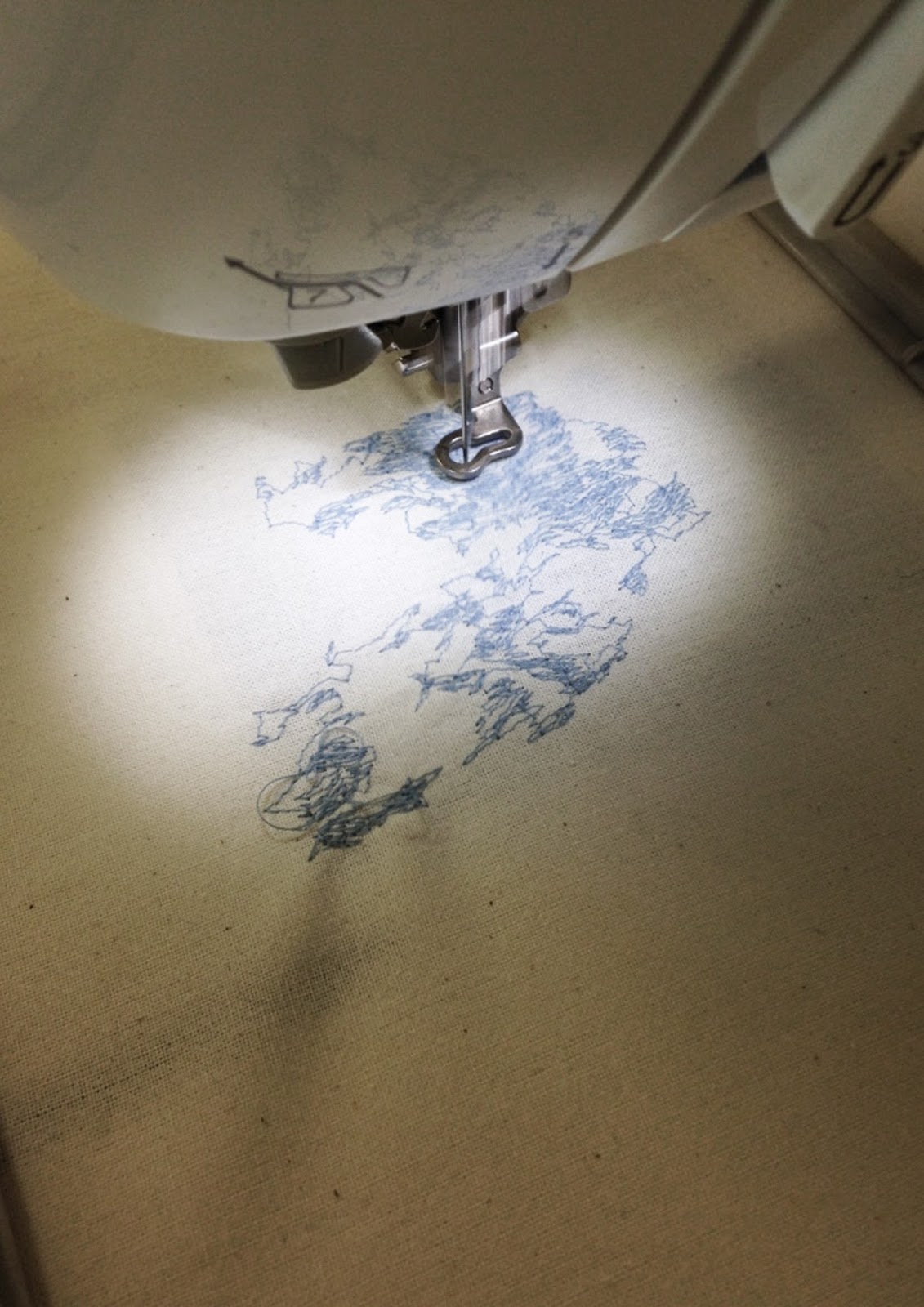
Experimentation 2 - Embroidery Designs.

I want some sort of image or design on my garments because it would be the only way to communicate the message about the impact of toxic dying.  However, I still want my piece to be modern, simplistic and simple. Because of these reasons, I did some research about the new upcoming trends for 2016 and discovered that embroidery on denim and on jackets was a new modern creative way of wearing jeans. It also gave the garments a 3D effect - which i thought could be a modern way of putting a photo on a garment.

I first used a photograph that i took without editing it before it was sewn on to the fabric.
The outcome was disappointing  - it wasn't clear and quite messy.
 This image shows the process of what the embroidery machine will do and what thread is needed to make the design.  I wasn't sure if the image on the computer would be exactly what it would look like on the fabric.
Looking at these photos, i think the first image looks more like water than the second image. - I think the more colour is used the more the image will get lost.


My second try with the embroidery machine was much better. Instead of using the image process on the program, I used the punch parameter.  The image is so much clearer and simple, i think it looks more like water than the first experiment - It looks more modern as well i think.


And because my theme is about water contamination by textile dyeing, I will only use white thread to make the pattern. Ive had to first really simplify the images I took before editing it on the program.

I really like only using white thread  and now i have the opportunity to naturally hand dye these patterns to share that knowledge that there are easy ways of dyeing textiles in an eco friendly way. 


Experimentation - Sublimation Printing.


I started off with sublimation printing for my experimenting. Ive combined my own images with Lu Guangs photographs of the area that has been affected by the contaminated waters. I thought visually this would give a great impact to the viewers - to give that strong message as well.

The print above was done on a scuba material, i did not edit the image before printing it and the outcome was quite purple in colour. This print is not as modern as i wanted it to be and I don't see how these realistic images would look professional on my garments. 

I decided to try the sublimation printing with just my images that i took of water. I first edited the colour by making the saturation very vibrant -- 
But the outcome wasn't what I was expecting, the colour was too vibrant and didn't give much of an impact. --


After designing this print on the illustration below I find it quite straightforward and seems as if there was not too much development in this design. 


Looking at these experiments made realise that this process does not relate to my concept or the message I am trying to convey through my garments. 

Japanese Dyeing.

I just discovered a new article on Vogue. com about a Japanese indigo dyeing technique. 
This article is very relatable to my project because its about natural Indigo dyeing and quite a traditional process in japan. And it is the only country where this natural dyeing process takes place. 


jacket and sweatshirt combined.

Studying the photographs of the villagers and workers in Xingtang, i noticed that not many wear clothing that have more than one function. I see them working in plain t-shirts and some not wearing anything, already I am planning on designing a simple sustainable t-shirt but i want to design something that can be functional- almost a two in one jacket/sweatshirt that can be worn outside as well as keeping the villagers warm.

Not only would these garments be functional but also sustainable, organic and environmentally friendly -  I would hope that being aware of this would make the workers and villagers understand that there are simpler and healthier ways of making clothes/dying clothes.

Below are inspirational and visual ideas of the jacket and sweatshirt I am going to design --


Waterles dying processes.

Natural Indigo dyeing.

I need to research more about waterless dying that can enrich my garments and encourage that message about how water does not need to be used in order to create colourful clothing.

 http://www.wildcolours.co.uk/html/indigo.html


Cotton is one of the world’s most popular fabrics for clothes. With indigo there is no need to mordant the fabric beforehand. Mordanting is a time-consuming process but most other natural dyes require you to mordant the cotton first. The original blue jeans were dyed with indigo.

Indigo was traditionally used to dye blue cloth in Japan. Indigo dye was long-lasting and practical, did not show the dirt and the Japanese believed that indigo dye protected the material against moths and insects.

I have noticed that even though Inidgo is a natural dying compound, you still need to use a large amount of water to create just a minor amount of fabric. -- I need to research ways of cleaning and purifying indigo-dyed water.

http://news.cornell.edu/stories/2013/09/treated-fibers-clean-dye-polluted-waters

http://www.popsci.com/blog-network/techtiles/problem-indigo


http://download.springer.com/static/pdf/178/art%253A10.1186%252Fs40691-014-0016-3.pdf?originUrl=http%3A%2F%2Flink.springer.com%2Farticle%2F10.1186%2Fs40691-014-0016-3&token2=exp=1461670082~acl=%2Fstatic%2Fpdf%2F178%2Fart%25253A10.1186%25252Fs40691-014-0016-3.pdf%3ForiginUrl%3Dhttp%253A%252F%252Flink.springer.com%252Farticle%252F10.1186%252Fs40691-014-0016-3*~hmac=8e93b58b050c41b235908fab7b31eabfdeaa18f51a52b457e06a75e62a5ade17


http://www.ncbi.nlm.nih.gov/pubmed/20389008

cationic hydrogels
sodium permanganate

Fique fibres from the fique plant purifies indigo-dyed fabric.


http://conservationmagazine.org/2013/12/fique-plant-cleans-up-dye/

http://pubs.rsc.org/en/content/articlelanding/2013/gc/c3gc40911b#!divAbstract -- Nano-enabled fique fibres.

https://36readyblog.com/2013/01/12/water-purification-simple-and-inexpensive-methods/

https://books.google.co.uk/books?id=05ORCwAAQBAJ&pg=PA102&lpg=PA102&dq=fique+fibres&source=bl&ots=LE6ncKii2b&sig=7znieV_U2I-3BGzkOLreiOWfe1I&hl=en&sa=X&ved=0ahUKEwia6Z2NnKzMAhVaOMAKHRtVBMIQ6AEIQjAG#v=onepage&q=fique%20fibres&f=false


After researching all these websites above, I have finally discovered a way of cleaning the water after it has been chemically contaminated with Indigo dye.
ChemistryLand. com conducted an experiement to see which resins would absorb the colour and toxins from the dyed water. Activated Charcoal was successful in filtering both the colour and toxins in the water.

http://www.chemistryland.com/CHM107Lab/Lab5/Filters/Lab5Exp2filters.html
Activated charcoal means it has been heated to increase its ability to absorb molecules. It is also used to filter and purify liquids, to absorb poisons (as in gas mask filters), and in emergency situations to neutralize swallowed poisons. 


Today I was unable to attend the photoshoot at Rush SkatePark in Stroud. Although i was prepared for the shoot I discovered some mis-calculations in my construction of the jeans and the neatness of my underwear was not the best as it could be.

I did use the over-locker machine to neaten the jeans and to get any threads cut off. Looking at my first outfit I am not satisfied with the quality and style of them. I think I needed to do more research on bras shapes and the construction of them before designing and sewing my own. I think that this could of been easier for me to get the measurements more accurate rather than estimating.

however, I think that the jeans are the best I could of done and all I need to do is sew some more hem lines to get an authentic Jeans effect and add rivets in the corners of all the pockets.

I have been updated by Elle magazine about the purpose of rivets on jeans. --

http://www.elleuk.com/fashion/news/icymi-those-little-metal-things-on-your-jeans-serve-an-important-purpose    --


I have bought two sewing patterns; one is for mens straight-cut jeans and the other is underwear for women.

What I plan to do is complete the bra first which will come from a sewing pattern and complete the underwear then I can move on to the mens outfit - which will just be the jeans and underwear.

Tomorrow I need to update my sketchbook, look at label designs for my jeans and accessories if possible.


If underwear and jeans are too risky for a fashion show I may have to consider designing sweatshirts which would be sustainable for the villagers in Xintang. - I have gathered inspiration of more modern shapes - and maybe the possibility of using the denim fabric rather than the organic jersey cotton.

Here is my Pinterest board where I source additional inspiration. --

https://uk.pinterest.com/beccymary98/photoshoot-the-tears-series/


Neil Kraft / KraftWorks.

http://www.kraftworksnyc.com/calvin-klein-2/


Neil Kraft is a creative director, his job is to get brands noticed by his co-oordinating and creative skills through photography, style and theme which works for each brand or organisation.

In the 90's, Calvin Klein was losing relevancy with consumers and needed to do something drastic to get his brand noticed. Neil was tasked with helping to reinvent the brand, which was important for changing the consumers perceptions. Neil modernised the brands logo, packaging and shopping bag, as well as helping launch and reconceive the groundbreaking CKOne and Obsession fragrances. All efforts further solidified Calvin Klein as the essential brand for young urban consumers.


© The Tears Series

This site uses cookies from Google to deliver its services - Click here for information.

Professional Blog Designs by pipdig